
On the bond market, long-term individual investors normally project a vision of two to three years at most down the road. Whenever it comes to a haven for long-term investment, real estate has always been a channel of their choosing. If bond investment pops up in their mind, they will compare it with the opportunity cost in real estate. It seems all assets are put in real estate perspectives.
An emerging economy in the development process always struggles with internal hardships, and failure to overcome such hardships will keep that country mired in that stage. Vietnam, despite enjoying fast growth in the past decade, has always had endemic problems to cope with.
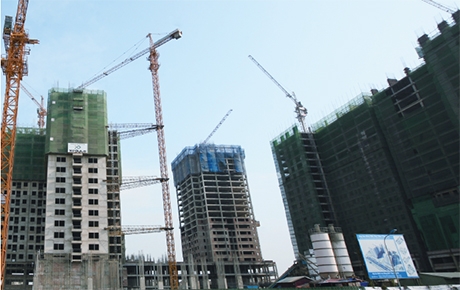
Although real estate boasts the second highest market capitalization, few enterprises in this sector capture the attention of investment funds (Photo: Nguyen Trung Au)
There are three major endemic problems in Vietnam’s economy: 1/ Regular risks of inflation as the economy heavily relies on credits; 2/ The economy is export-driven and reliant on foreign investment, and as such, maintaining forex rate stability is a top priority; 3/ The society is now mired in real estate.
In the past ten years, with strong efforts by the Government and the State Bank of Vietnam, the two problems of inflation and forex rate risks have been fixed, giving way to macro-economic stability. However, the real estate problem has remained a huge headache, which has worsened lately due to the imbalance between housing segments and the illogical real estate fevers across the country.
High housing prices as the bottleneck
The housing price index in Thailand over the past 30 years has remained stable, but the housing price in Vietnam has steadily risen, and during land fevers, prices even skyrocketed to a level several times higher than the real value.
Stable real estate prices have enabled Thai businesses – service providers and manufacturers alike – to develop strongly. Visitors to Thailand will tell how prices are quite reasonable at shopping malls, largely owing to the low rent at such trade centers. Conversely, high rents at shopping centers in Vietnam exert a heavy burden on retailers. High rents push up retail prices, thus eroding the competitiveness as vendors struggle to lure shoppers.
The feverish real estate market also impedes the country’s industrialization drive. Manufacturers find it tough to access capital. In mobilizing capital, be it from banks or via bond or share issues, manufacturers and other industrial players are at a disadvantage when competing with real estate firms.
Data on investment performance of listed firms show the dominant position of real estate enterprises. In the meantime, enterprises in other industries have seen their investment activities choked off. This trend was seen not only in 2022, but in the past several years. Outstanding credits for the real estate sector have always occupied the top spot, while in the bond issuance activity, real estate companies have competed shoulder to shoulder with banks. If the banking industry as the money supplier for the entire economy assumes the top position, the real estate sector is the second most important industry, so to say.
Paradox in investment funds’ portfolios
Although real estate boasts the second highest market capitalization, few enterprises in this sector capture the attention of investment funds, which fix their eyes on the shares of real estate giants only. Moreover, the proportion of real estate securities in the portfolios of investment funds is quite low compared to a high proportion of 25%-30% in the market capitalization of the securities benchmark VN-Index.
The key reason behind this lukewarm response by investment funds is because real estate shares are sensitive to business cycles and speculation. Real estate shares can hardly sustain growth like those in other manufacturing and service industries to allow for long-term holding. Meanwhile, other industries like retailing and banking are preferred by investment funds as these industries are closely associated with the country’s economic development. Such a trend also explains the volatility of real estate shares on the stock market.
Opposite to investment funds, individual investors hold a short-term vision when investing in stocks, normally between one and two years, which means it is a short-term investment vehicle although the stock market by nature is a supplier of long-term capital for enterprises. As the market mainly gathers short-term investors, it proves difficult for enterprises to mobilize funds for their long-term development. That also similarly applies to bonds. As most individual investors eye short-term bonds, issuers also have to respond to such short-term demands. It will pose huge liquidity risks when enterprises use short-term capital to finance their long-term business plans.
It is no wonder that the Chinese government in the past five years has gradually tightened control over the real estate market to steer capital from the real estate sector into the stock market. The context is similar in Vietnam. From a macro-economic perspective, the real estate sector is creating a major bottleneck to the cashflow, choking off capital for other economic sectors. Pools of surplus capital from institutions and individuals have for the most part been channeled into real estate for short-term profits as well as for long-term investment, with the expectation of high profit margins, adversely affecting other traditional financial vehicles like shares and bonds.
Recent efforts by the Government to rectify the real estate market show the strong determination to improve the market and to create favorable conditions for upgrading Vietnam’s stock market in the coming time. Once the bottleneck is removed, the cashflow will be channeled into other long-term investment vehicles like shares and bonds to supply long-term capital for enterprises.
Le Hoai An (CFA) – Dong Hoang Huong Lien (HUB)
(The Saigon Times)