
While the Ministry of Transport is pushing for green transport to achieve net-zero emissions in Vietnam, the sector is still struggling to secure funding for its initiatives.
Le Van Duong, head of the Department of Science, Technology, and Environment under the Ministry of Transport (MoT), is focused on attracting more green finance in order to support this transition.
“Learning from domestic and international experts, we will advise the MoT on policies to attract investment, which will then be submitted to the government for approval, aiming for net-zero by 2050,” he said.
Transport financing vital for 2050 targets
He acknowledged that securing funding remains a significant challenge. For example, the development of two metro lines in Hanoi has taken over a decade due to financial issues. Similarly, in Ho Chi Minh City, the Ben Thanh-Suoi Tien metro line’s operation has been delayed until the end of 2024, instead of the originally planned 2015, due to legal hurdles such as investment adjustments and capital balancing.
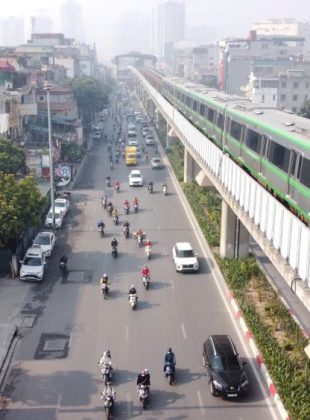
To date, the MoT has implemented various initiatives, including urban railway lines, hundreds of electric buses, and tens of thousands of electric vehicles (EVs), to develop green transport infrastructure. The latest developments include the operation of the Nhon-Hanoi Railway Station metro line in early August, following the Cat Linh-Ha Dong line in late 2021.
Plans are also in place to expand these efforts. Under Hanoi’s transportation planning towards 2030, with a vision to 2050, the city aims to develop 10 metro lines spanning 413km. In Ho Chi Minh City, six metro lines are planned by 2035.
However, the path to net-zero requires more action. Minister of Transport Nguyen Van Thang said, “Compared to the set goals, this is just the beginning. We must continue attracting resources and implement priority mechanisms to encourage business participation.”
At a national policy dialogue on green transport in late August, experts highlighted the lack of specific policies and mechanisms to attract private investment. Nguyen Ngoc Dong, former Deputy Minister of Transport, noted the need for comprehensive infrastructure development, including charging stations, ports, airports, and railways.
“Achieving net-zero as committed is a huge challenge. We should reconsider our policies for attracting resources and adjust the legal framework accordingly,” Dong said. “The state’s initial investment for infrastructure must continue to engage international resources.”
“Partners have made commitments and are ready to invest, but Vietnam must meet certain conditions, such as effectively attracting private sector participation in key areas like transitioning energy and transport modes. Once resources are unlocked, the implementation must be well-coordinated to ensure effective disbursement.”
Le Anh Tuan, chairman of the University Council at the Hanoi University of Science and Technology, proposed a national electric vehicle transition programme with three phases: startups (2024-2030), rapid growth (2030-2040), and stable growth (2040-2050). This will include specific measures to promote EVs, develop infrastructure, and strengthen international cooperation.
International organisations have pledged to support Vietnam’s green transport development, including the Japan International Cooperation Agency (JICA), South Korea’s Economic Development Cooperation Fund (EDCF), the Asian Development Bank, the World Bank, and more.
Takebayashi Yoko, deputy chief representative of JICA in Vietnam, highlighted that over the past 30 years, it has supported Vietnam with transport infrastructure development investments totalling over $20 billion. “JICA is actively involved in urban railway projects in Hanoi and Ho Chi Minh City and is ready to collaborate further,” she said.
Jin Saeun, chief of the EDCF’s representative office in Hanoi, reiterated South Korea’s commitment to green transport infrastructure in Vietnam.
“We have established a green building rating system for assessing projects and are committed to fully supporting Vietnam in achieving its net-zero target by 2050,” he said.
Do Le Ninh, senior investment officer Private Sector Operations Asian Development Bank:In other regional countries like Thailand, the Asian Development Bank (ADB) has completed several transactions. However, in Vietnam, we’ve only completed one transaction with VinFast, signed two years ago. In Vietnam, there is a lack of understanding about green finance. Many believe it simply refers to low-interest capital. In reality, green finance means that organisations, sponsors, and banks commit to investing a certain portion of their resources into green projects and must meet specific goals. But how do we determine if a project is truly green? There are global standards to verify this, but these are still underdeveloped and need further refinement. There remain many controversial issues surrounding this determination. The ADB’s goal is to disburse $100 billion by 2030 to address climate change and reduce carbon emissions. Any lending projects must meet two criteria: they must have a significant development impact, such as transitioning to electric transport, and they must be financially viable. We evaluate projects on a case-by-case basis. Our lending operates on market principles, meaning the riskier the project, the higher the interest rate. Luu Quang Thin, deputy head Planning and Investment Ministry of Transport:In the development direction for transport infrastructure towards 2030, with a vision to 2050, Vietnam aims to build a balanced transport infrastructure system, capitalising on various transport modes while increasing the market share of public passenger transport in major cities. Several key solutions have been proposed to mobilise investment resources. We are committed to reviewing, amending, and improving the legal framework, streamlining administrative procedures to enhance the investment environment, and strengthening the decentralisation of power to localities to boost investment. Additionally, we are aligning transport infrastructure investment with green energy transition goals and carbon emission reduction targets. Priority will be given to allocating the state budget to transport infrastructure projects that struggle to generate investment returns or pull in capital from the private sector. This includes infrastructure projects that contribute to the country’s carbon emission reduction commitments, such as national railways and urban rail systems. We will also mobilise capital from all economic sectors for transport infrastructure development, providing maximum investment incentives. Moreover, we will continue to engage and effectively utilise official development assistance and concessional loans from international donors for large-scale, high-impact projects. Additionally, we plan to leverage infrastructure assets more effectively and develop mechanisms to mobilise investment resources in line with the specific characteristics of each transport segment, ensuring international competitiveness. By 2030, we aim to announce a list of transport infrastructure development projects to pull in investment through public-private partnerships and foreign investments. |
Bich Thuy
(VIR)