Vietnam’s more than 430 industrial parks (IPs) have been the backbone of its manufacturing sector since “Doi Moi” (Economic Renewal) was introduced 40 years ago. They have helped turn the country into a major FDI destination and an export powerhouse, with electronics, computers, and components alone reaching $108 billion in 2025. Yet the traditional IP 1.0 approach, built primarily around land provision and low-cost manufacturing, will increasingly need to evolve into specialized, technology-enabled industrial ecosystems.
According to a Roland Berger report and outlook, Vietnam’s IPs enter the new IP 2.0 era as high-tech manufacturing reshapes infrastructure demand. “Vietnam’s next industrial advantage will come from IPs that turn land into sustainable, globally-connected production ecosystems,” said Mr. Truong Bui, Partner at Roland Berger and Head of Roland Berger Vietnam.
From traditional parks to tech-based ecosystems
Pre-Doi Moi, an “industrial park” in Vietnam was referred to as an “industrial zone”. Then, the model evolved in stages: the first traditional industrial park in 1993, the first high-tech park in 1998, the first eco-industrial park (eco-IP) in 2006, and the first integrated township and smart park in 2022.
IPs have delivered broad economic benefits over the years, with export growth their most powerful contribution. According to data from the National Statistics Office at the Ministry of Finance, exports of electronics, computers, and components rose from $45 billion in 2020 to $108 billion in 2025, at a compound annual growth rate (CAGR) of 19 per cent, and now account for 23 per cent of national export turnover. Manufacturing and processing also attracted 54.7 per cent of Vietnam’s FDI in 2025.
However, infrastructure and logistics lag behind Vietnam’s peers. According to Roland Berger, the country’s industrial growth is now facing three structural limitations: infrastructure that is failing to keep pace with global industrial standards; a workforce skills base that is insufficient for higher-value manufacturing; and an industrial position concentrated at the assembly and low-value end of global value chains.
First, Vietnam’s industrial infrastructure is misaligned with the requirements of modern manufacturing investment across three dimensions: energy, connectivity, and environmental, social, and governance (ESG) practices. On energy, the power grids remain underdeveloped, posing real operational risks for energy-intensive industries. On connectivity, the current multimodal network limits IPs’ ability to integrate efficiently into regional and global supply chains. And on ESG, only six of Vietnam’s more than 430 IPs have achieved GEIPP (Global Eco-Industrial Parks Programme) certification and only seven have been formally designated as eco-IPs.
Second, Vietnam faces growing pressure to close its skilled labor gap as high-tech investment accelerates. While investment in sectors such as semiconductors, electronics, and digital technology continues to accelerate, workforce readiness has yet to fully keep pace. In 2025 only about 24 per cent of the manufacturing workforce was formally trained, highlighting the infrastructure and talent challenges that accompany the shift toward higher-value production.
Third, Vietnam remains concentrated in assembly-led manufacturing, with limited participation in higher value activities such as R&D, product design, and technology development. In industries such as electronics, localization rates remain low at around 5-10 per cent, with production still heavily reliant on imported components and outsourced technologies.
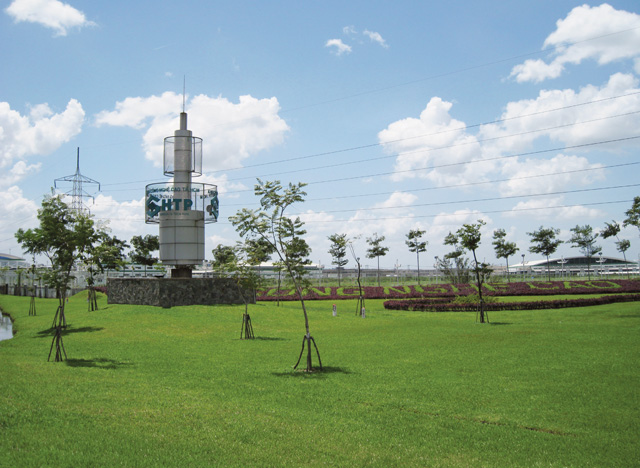
Vietnam has gradually moved beyond the IP 1.0 model centered on basic FDI attraction and low-cost manufacturing toward more advanced industrial development models. In the IP 2.0 phase, the country has introduced eco-industrial and high tech parks such as Saigon Hi-Tech Park and Hoa Lac High-Tech Park, combining cleaner production with R&D activities to move into higher-value segments of the global value chain.
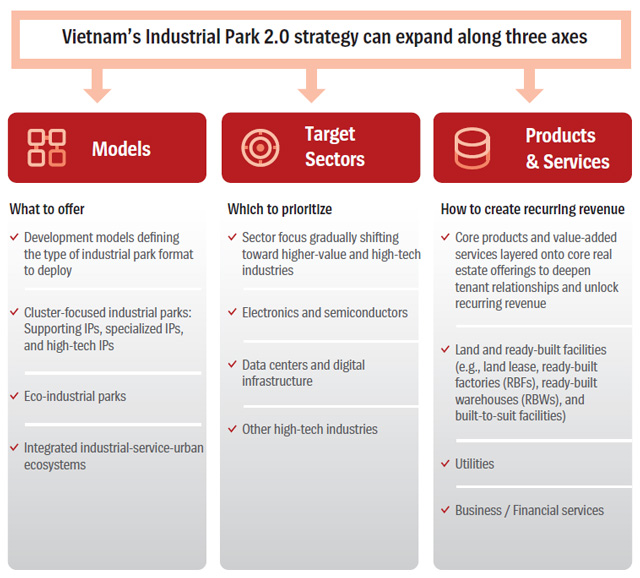
Looking ahead, Vietnam is increasingly shifting toward eco-industrial models and integrated industrial-service-urban ecosystems that seamlessly combine manufacturing, digital infrastructure, logistics, and urban services within a unified development framework. According to Mr. Long Vu, Senior Project Manager at Roland Berger, future-ready parks will win by helping tenants produce cleaner, move faster, and integrate deeper into value chains.
Unlocking new opportunities
Rising geopolitical tensions, tightening trade controls, and accelerating investment strategies are reshaping manufacturing footprints across Asia, driving multinational corporations to diversify production bases and strengthen supply chain resilience. Against this backdrop, Vietnam continues to reinforce its position as a preferred manufacturing and export hub, supported by stable macro-economic fundamentals, expanding free trade agreements (FTAs), and sustained high-quality FDI inflows. These trends are accelerating demand for industrial land, logistics infrastructure, and more integrated IP ecosystems.
At the same time, Vietnam is accelerating a new wave of industrial transformation through Politburo Resolution No. 57-NQ/TW and the enactment of the Law on the Digital Technology Industry 2025, which prioritizes strategic sectors such as semiconductors, AI, digital technology, and digital assets. The introduction of dedicated incentive mechanisms, concentrated digital technology parks, and regulatory support for high-tech industries is expected to strengthen Vietnam’s attractiveness for innovation-driven investment.
Vietnam’s next IP phase is anticipated to shift from scale-driven expansion toward ecosystem quality, sector specialization, and higher-value industrial positioning. Accordingly, IP development is shifting from generic multi-sector formats toward specialized and high-tech IPs that better align with evolving tenant requirements. At the same time, eco-IPs and integrated industrial-service-urban models are gaining importance as ESG, energy resilience, sustainability, and talent attraction become increasingly critical to long-term competitiveness.
Additionally, demand is increasingly shifting toward higher-value and technology-intensive industries such as electronics, semiconductors, data centers, and advanced manufacturing. This trend is reinforcing the need for more advanced infrastructure, stronger digital readiness, and deeper ecosystem capabilities to support Vietnam’s push toward high-tech and digital technology industries under Politburo Resolution No. 57.
IP developers are also expected to expand beyond traditional land leasing into broader value-added offerings such as ready-built facilities, utilities, smart infrastructure, business support services, and sustainability solutions.
As industrial development shifts toward higher-value and technology-intensive sectors, demand is expected to rise for next-generation IPs offering specialized infrastructure, digital capabilities, ecosystem services, and stronger connectivity to talent, R&D, and logistics networks. This transition is accelerating demand for sector-focused IPs with integrated infrastructure and higher operational sophistication, particularly in electronics, semiconductors, data centers, and advanced manufacturing. “Vietnam’s next industrial advantage will come from IPs that turn land into sustainable, globally-connected production ecosystems,” Mr. Bui believes.
Hoang Anh