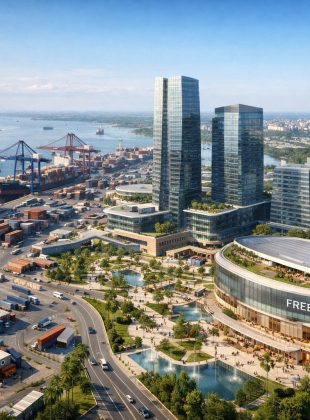
Transit Oriented Development is meant to improve urban transport capabilities and reduce traffic jams as well as combine socio-economic development and environmental protection.
Transit Oriented Development (TOD) has emerged as a pivotal approach in Hà Nội’s urban planning to integrate public transport systems with other urban development.
While it offers immense potential for sustainable urbanisation and economic growth, it also presents significant challenges in planning and implementation.

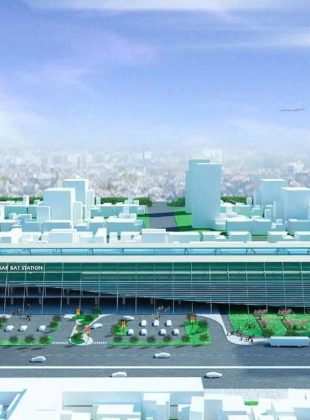
The Nhổn – Hà Nội Station urban rail line. (VNA/VNS Photo)
According to Nguyễn Cao Minh, head of the Hà Nội Metropolitan Railway Management Board (MRB), urban railways are not only a sustainable public transport solution, but also a catalyst for socio-economic development.
However, urban railways will require integration between urban transport and planning to realise their full potential, said Minh.
In the current context, TOD is a suitable strategy for the city’s development, he said.
TOD is meant to improve urban transport capabilities and reduce traffic jams, combine socio-economic development and environmental protection, and bring added value from land and other sources for re-investment into infrastructure, Minh noted.
However, TOD also poses urgent problems that must be resolved with clear and appropriate policy corridors, especially planning issues.
Hà Nội authorities have planned to develop an urban railway system with 15 lines alongside the development of 91 urban areas by 2045, according to the TOD model.
Hoàng Thu Thủy, deputy head of the Hà Nội Construction Department’s urban development section, said that the department has been assigned to help the city’s People’s Council guide the implementation of the Capital Law on urban renovation, embellishment and development.
This task is closely related to TOD planning solutions.
“The TOD model will inevitably swap and rearrange residents’ land in the area that will become the TOD urban area,” Thuỷ said.
Meanwhile, Trịnh Quang, an expert from the Infrastructure and Green CITY Programme, said that planning issues are one of the core elements for TOD, which is a combined planned model that needs other detailed plans within its scope.
“The planning of TOD areas is related to the urban railway system, underground infrastructure, underground space details, and safety and environmental issues. Is it therefore necessary to consider supplementing the special planning of TOD or not?” he asked.
Quang also said that switching to a land use fee collection mechanism is necessary to exploit the benefits of TOD, along with potentially even moving towards restructuring the urban space entirely.
He said: “But the complexity is that, even when there is a TOD plan, land use rights still belong to many different groups, both private and State-owned. So the question is how to have a ‘conductor’ regulate and harmonise rights and interests related to land to synchronously develop TOD areas.”
Former vice chairman of the Hà Nội People’s Committee Nguyễn Văn Khôi said: “For areas identified for urban development according to the TOD model, even if there is no planning for approval, it is recommended that the city still prioritises land funds first.”
“With the current rapid urbanisation rate, the land fund will gradually run out, leading to a shortage. TOD planning must state how much land is needed, including preliminary calculations around the stations to create urban and commercial areas so that the city can reserve the land fund,” he added.
Planning must be made public
According to the MRB, implementing the TOD model in the capital still faces many challenges due to the unsynchronised planning process, lack of coordination between agencies and departments, limitations on financial mechanisms and difficulties in land acquisition.
Aside from these issues, increasing inclusion and ensuring social and economic justice are also major barriers in implementing TOD.
Minh said that what the TOD model needs most now is planning and then investment to reduce many duplicated steps in procedures.
“TOD is an opportunity for urban reconstruction. The policy mechanism to shorten the investment process is built on a scientific basis and thorough research, including many layers of planning,” he said.
Director of the Việt Đức Transportation Research Centre Dr Vũ Anh Tuấn said: “After the TOD planning is completed, it will be possible to determine which land plots are likely to be prioritised for implementation, and investors can make a project investment proposal.”
Deputy director of the Hà Nội Department of Planning and Investment Lê Trung Hiếu said it is necessary to allow the application of architectural planning criteria, technical infrastructure, social infrastructure, space and land use requirements other than those prescribed in national technical regulations, as well as flexible adjustment of planning in the TOD area according to market development trends.
“As for land accumulation, according to international experience, it is a prerequisite that determines the success of the TOD model,” he said.
“Therefore, there need to be regulations, mechanisms and policies to implement compensation, support, resettlement and land recovery to ensure benefits for people, the State and businesses for maximum accumulation,” Hiếu said.
Experts say that planning TOD areas is the first thing to do on the roadmap to realising Hà Nội’s urban development goals.
Planning is both a scenario and a premise for investment preparation and land accumulation, as well as a basis for advocacy and enlisting the support of the people.
(VNS)