Investing in high-tech projects that utilise clean raw materials and reduce carbon emissions into the environment is the current global trend.
Traditional industrial zones are gradually losing their competitive edge and being replaced by industrial zones that prioritise green and sustainable elements, making them more appealing to investors, said experts.
The development of green industrial zones involves participating in cleaner production practices and minimising negative environmental impacts, with the aim of achieving zero carbon emissions by 2050. Building green industrial zones to attract investment in the green industry is a prevailing global trend.
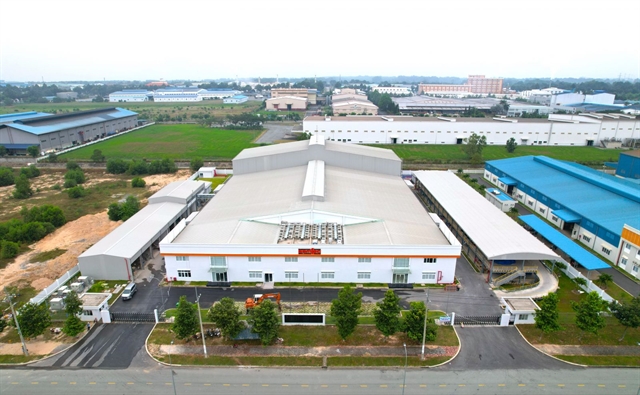
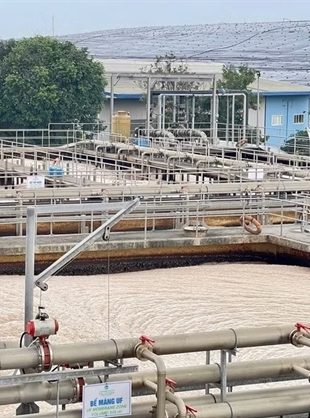
Factories at the Long Thành Industrial Park in Đồng Nai Province. (Photo: szl.com.vn)
From a management perspective, Deputy Minister of Planning and Investment Nguyễn Thị Bích Ngọc said that the transition towards a green and circular economy in industrial zones and economic zones is a crucial factor in enhancing competitiveness and ensuring sustainable development for each specific area and the overall economy.
With 403 operational industrial zones, promoting the development of eco-industrial zones will mobilise significant resources from the private sector to implement green industrial solutions, ensure energy security, and make a substantial contribution to Việt Nam’s climate change mitigation efforts.
This will drive green growth and circular economy practices, reflecting the strong political commitment of the Vietnamese Government towards sustainable development.
The summary report on 30 years of industrial zone and economic zone development by the Ministry of Planning and Investment showed that by 2030, 40-50 per cent of localities will have plans to convert existing industrial zones into eco-industrial zones, while 8-10 per cent of localities will aim to establish new eco-industrial zones, starting from the stage of construction planning and industry-specific investment attraction.
The simultaneous focus on constructing new eco-industrial zones and transforming traditional industrial zones into eco-industrial zones is evident.
MB Securities JSC (MBS) has observed a trend of investment capital shifting towards secondary markets located away from major cities due to their large supply and lower rental prices.
Despite facing new challenges, there are several supporting factors in the development of industrial real estate. Currently, India and Indonesia are the biggest competitors with Việt Nam in attracting foreign direct investment (FDI) in the high-tech sector.
Nevertheless, the country holds competitive advantages thanks to signed trade agreements and attractive labour and electricity costs. Strengthening the strategic partnership with the US will also contribute to attracting investment in high-tech development.
In the northern region, there is a noticeable trend of FDI capital flowing into secondary markets. For example, Quảng Ninh Province has attracted over US$3.1 billion in FDI, ranking third nationwide in 2023. The Jinko Solar Hai Ha photovoltaic cell project, with a $1.5 billion investment, stands out as a representative example.
Bắc Giang Province has also successfully drawn in $3 billion in FDI, 2.5 times higher than the previous year, with the Hana Micron Vina 2 semiconductor production project contributing $0.6 billion.
The proportion of FDI inflows into secondary markets has shown a significant increase, from 20 per cent in 2018 to 53 per cent in 2023.
This can be attributed to lower industrial land rental prices compared to primary markets in major cities, as well as the availability of ample commercial land with a market occupancy rate of only 64 per cent in the secondary market.
In the southern region, there is a rising trend in the proportion of FDI capital flowing into secondary markets in 2023, up from 21.6 per cent in 2022 to 23.2 per cent in 2023.
Bà Rịa-Vũng Tàu Province attracted over $1 billion in FDI, with a notable investment of $540 million in Hyosung Vietnam’s fibre and carbon material production project.
Bình Phước Province successfully lured over 40 FDI projects with a total investment of $758 million, marking a 3.4-fold increase over 2022.
The growth was mainly driven by the advantages of the availability of industrial land for leasing, as the occupancy rate in the secondary market is only 63 per cent, while the primary market has reached 90 per cent.
Moreover, rental prices in the secondary market are only half those in the primary market.
By the end of 2023, the total industrial land area in Việt Nam reached 89,200ha, up 1.5 per cent from the end of 2022, mainly thanks to the growth in the northern market.
The total leased industrial land area reached nearly 51,800ha, a 5.7 per cent increase over the end of 2022, with an occupancy rate of around 57.7 per cent.
For operational industrial zones specifically, the occupancy rate reached approximately 72.4 per cent. Rental prices in the southern region remained stable at $168 per sq.m, while rental prices in the northern region increased by 10 per cent from the end of 2022 to $123.
MBS believes that the prospects of the industrial park industry in the future come from stable macroeconomic conditions and improving relations with major economies to help maintain the momentum of rising FDI.
New obstacles arise
However, new challenges will come in the form of increased competition from other countries or the risk of electricity shortages impacting production.
Enterprises with large clean land funds and healthy finances will have long-term growth potential.
SSI Securities Corporation said that disbursed FDI capital into Việt Nam reached $23.2 billion last year, an increase of 3.5 per cent year-on-year, mostly focusing on the manufacturing sector.
Meanwhile, the total committed FDI capital in 2023 rose 24.4 per cent on-year to $28.1 billion.
As a result, the securities firm expects FDI capital to continue to maintain growth in 2024, focusing on the manufacturing sector (manufacturing and semiconductor enterprises) and renewable energy.
SSI said that many listed industrial park investors have signed a Memorandum of Understanding (MOU) on leasing industrial land to new tenants in the second half of 2023, so these MOU contracts are likely to be converted into official contracts and recorded as revenue in 2024.
For industrial parks in the north, demand for industrial park land rental is expected to be high in 2024, driven by the trend of shifting production facilities to Việt Nam, mainly in the electronics and semiconductor industries.
Industrial parks in the south may record a technical recovery from a low base in 2023, with the main businesses leasing industrial land being manufacturing businesses (textiles, wood, footwear), logistics and food and beverages.
Thanks to the favourable business environment, many industrial real estate companies reported large profits in 2023.
For example, Becamex (BCM) reported a revenue of about VNĐ8.2 trillion in 2023, an increase of nearly 25 per cent from the previous year, while its profit after tax reached over VNĐ2.3 trillion, the highest level since 2020.
Sonadezi Long Thành (SZL)’s net revenue was VNĐ441 billion last year and profit after tax was VNĐ104 billion, up 7 per cent and 4 per cent year-on-year, respectively. Meanwhile, Sonadezi Châu Đức (SZC) posted a profit of VNĐ218.87 billion in 2023, up 10.89 per cent from the year before.
Thanks to positive business results, the group of industrial real estate stocks also performed strongly recently, such as in the week to February 2, SNZ increased by 22.74 per cent, SZC rose 8.52 per cent, Sai Gon VRG Investment Corporation (SIP) climbed by 7.73 per cent, IDICO Corporation (IDC) increased by 7.37 per cent, BCM was up 4.44 per cent, and SZL increased by 1.96 per cent.
(VNS)