
Vietnam’s real estate sector continues to consolidate its position as a major magnet for foreign investors, ranking second only after processing and manufacturing in newly registered foreign direct investment (FDI).
As of late October, the property market had drawn 2.75 billion USD in newly registered capital and about 1.5 billion USD in disbursed funds, signalling not only sustained appeal but also a shift towards a new generation of foreign investment.
Analysts attribute this momentum to an improved investment policy framework and a more transparent, business-friendly environment. Vietnam has accelerated administrative reforms, digitalised procedures and enhanced transparency in land allocation and management—key factors in reducing costs and risks for foreign investors in a sector traditionally shaped by stringent regulations.
Recent revisions to the Land Law, the Housing Law and the Law on Real Estate Business have further enabled mergers and acquisitions (M&A), equity participation and foreign involvement in property projects. This has fuelled an increase in M&A transactions as overseas investors seek high-potential development sites.
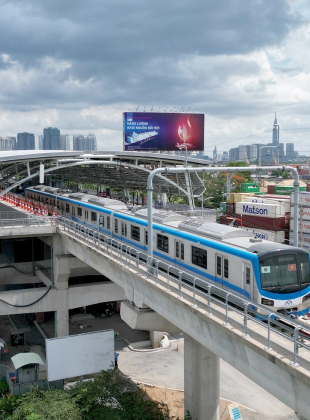
Infrastructure expansion and rapid urbanisation are also drawing significant foreign capital. Vietnam is in a phase of intensive investment in transport networks, including major highways, bridges, metro lines and airports. This is boosting interest in industrial and logistics facilities as well as satellite urban areas. FDI is increasingly flowing not only into traditional industrial parks but also into green industrial zones, port-linked logistics hubs and new urban developments connected to high-quality infrastructure.
Turning point
At the recent Vietnam Industrial Property Forum (VIPF) 2025, experts described the current phase as a “turning point” for infrastructure developers to reposition themselves and capture emerging global capital flows.
Market confidence and the revival of domestic enterprises are reinforcing this trend. By the end of the third quarter of 2025, nearly 4,700 new real estate firms had been established, up 20.3% year on year. The expansion in scale and capacity of Vietnamese property developers reflects renewed confidence in the sector and offers a strong foundation for deeper cooperation with international investors on strategic projects.
According to Troy Griffiths, Deputy Managing Director of Savills Vietnam, FDI inflows remain stable and are improving in quality. Investment in industrial, technological and property-related projects is strong. Hanoi alone attracted 3.5 billion USD in FDI last quarter, with more than 3.1 billion USD directed into real estate—an indication of international investor confidence.
Vietnam is moving beyond competing on low-cost advantages, Griffiths said, noting that investment is shifting towards high technology, semiconductors, computing and value-added manufacturing. He emphasised that infrastructure development will be the most significant growth driver over the next decade, while rapid urbanisation will spur the rise of satellite cities as new development hubs.
Assoc. Prof. Dr Le Thu Ha of Hanoi University of Architecture noted that newly completed expressways and major infrastructure projects such as airports and seaports are creating strong pull factors for FDI. She said rising demand for green industrial parks and high-quality logistics facilities presents major opportunities, but stressed the importance of proactive, integrated planning to avoid fragmentation.
Vietnam’s GDP is forecast to reach 480–500 billion USD by 2035—almost triple current levels—with annual growth of 7–8%. Urbanisation is expected to reach 50%, equivalent to around 51 million people, while the expanding middle class could account for 75% of the population, driving strong demand for housing, commercial space, tourism and healthcare.
This period marks Vietnam’s transition from a “land accumulation” model to one centred on “value creation”. The market is expected to see a greater role of institutional investors and long-term international capital focused on sustainable development, Griffiths said.
The Government is advancing legal reforms and new capital-mobilisation mechanisms, including infrastructure bonds and digitalised market oversight, to cultivate a transparent and modern investment environment. Climate change, while posing challenges, is also generating opportunities for green investment as Vietnam positions itself as a regional leader in Net Zero and climate-resilient infrastructure.
Despite risks related to exchange-rate fluctuations, global inflation and implementation capacity, experts remain confident that Vietnam will continue to be among Asia’s most attractive investment destinations./.
(VNA)