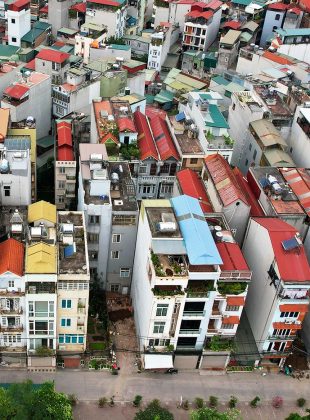
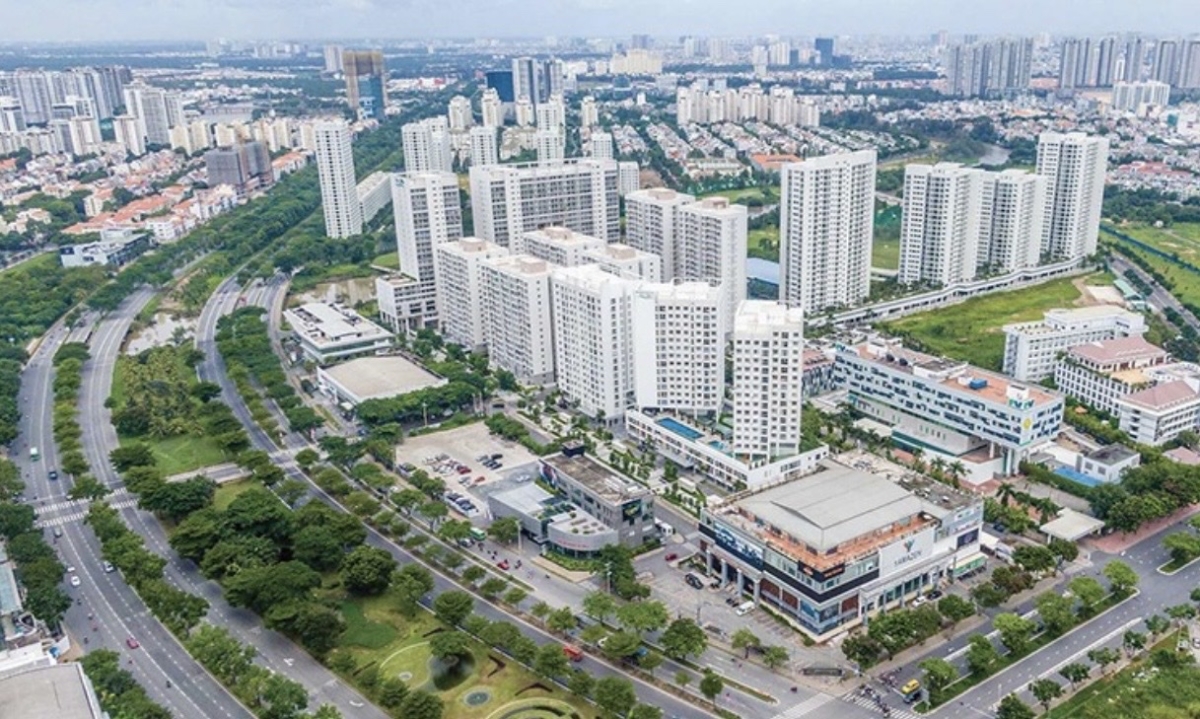
Differences in growth drivers are shaping an uneven recovery landscape and setting distinct development trajectories for Vietnam’s two major property markets. While Hanoi has shown early signs of revival, underpinned by strong end-user demand in inner-city areas and a clear spillover effect from Ring Roads, Ho Chi Minh City is being driven primarily by regional connectivity infrastructure and the accelerating trend of population decentralization towards satellite cities.
According to a survey conducted by property platform Batdongsan.com.vn, 48 per cent of real estate brokers said transaction activity in the fourth quarter of 2025 declined quarter-on-quarter, while only 14 per cent reported an increase and 35 per cent described the market as stable. In analyzing Vietnam’s two largest markets, Mr. Dinh Minh Tuan from Batdongsan.com.vn said the most notable difference between the two lies in their respective recovery drivers.
Infrastructure reshapes Hanoi
Infrastructure development, particularly Ring Roads and river-crossing bridges, is reshaping Hanoi’s real estate landscape. Data from Batdongsan.com.vn shows that the number of apartment projects located near Ring Roads has increased nearly 2.6-fold, from 269 prior to 2015 to almost 700 at present.
The apartment segment continues to act as the market’s primary growth engine, with demand gravitating towards areas along Ring Roads 2 and 3. In the first eleven months of 2025, the former Nam Tu Liem district recorded the highest level of interest in apartments, followed by Ha Dong, Cau Giay, and the former Hoang Mai district.
Price movements, however, reveal a notable shift. The sharpest price increases in the fourth quarter did not occur in the inner city but instead in areas along Ring Road 3.
These gains far outpaced those in many central districts such as former Ba Dinh and Hai Ba Trung, where price growth ranged from just 69 to 92 per cent. This reflects a capital shift towards areas with lower price bases and the emergence of large-scale new urban developments.
A similar trend is evident in the landed house segment. Though overall interest has declined, prices continued to rise across most areas of Hanoi, with stronger increases seen in near-central districts where price levels remain relatively low. By the fourth quarter of 2025, asking prices in the former Ha Dong, Hoang Mai, Bac Tu Liem, and Long Bien districts had risen by more than 110 per cent compared with early 2023.
In the shophouse segment, rental demand in the fourth quarter rose 9 per cent quarter-on-quarter, while interest in purchases fell 6 per cent. Despite this, rental yields have not improved, as selling prices climbed sharply while rents remained flat.
Notably, buyer demand in Hanoi is increasingly shifting beyond the city’s traditional market. Batdongsan.com.vn data shows that the share of Hanoi-based buyers searching for property within the capital fell from 81 per cent in the first quarter of 2023 to 59 per cent by the fourth quarter of 2025.
HCMC surges amid decentralization
In Ho Chi Minh City, Batdongsan.com.vn representatives said metro lines, the Ben Luc – Long Thanh Expressway, and bridge networks linking it with Dong Nai province are creating strong momentum for satellite cities such as Thuan An, Di An, and the former Vung Tau area.
Apartments remain the leading segment as supply continues to expand rapidly. Before 2015, apartment supply was largely concentrated within Ring Road 2 in the city center, with 324 projects. As Ring Roads 3 and 4 have gradually taken shape, urban expansion has accelerated, allowing developers to move outwards. As a result, the number of apartment projects has surged to around 1,050 today, up 3.2-times in just a decade, primarily shifting towards the city’s northeast.
Apartment asking prices continued to rise significantly in the fourth quarter of 2025. Standout increases were recorded in the former Nha Be district (up 64 per cent), former District 7 (up 63 per cent), former Binh Thanh district (up 57 per cent), and Thu Duc city, with gains ranging from 32 to 48 per cent compared to the first quarter of 2023. Rising prices and housing demand have also spread to expanded central areas of the southern city.
In the landed house segment, transaction activity remained stable despite modest growth in interest. Batdongsan.com.vn data shows that in central Ho Chi Minh City, asking prices for landed houses in the fourth quarter of 2025 typically ranged from VND210 million ($8,075) to VND286 million ($11,000) per sq m, or 1.4 to 2.2-times higher than apartments. Moving outward to former districts such as Binh Thanh, Phu Nhuan, District 11, and District 7, prices fell to around VND125 million ($4,810) to VND204 million ($7,845) per sq m, indicating easing price pressure.
Mr. Tuan advised that investors at this stage should rely on data to identify locations with genuine growth drivers rather than chasing sentiment-driven waves or market rumors amid ongoing polarization.
Appeal of residential property
Mr. Troy Griffiths, Deputy Managing Director of Savills Vietnam, said the market entered 2025 in a relatively subdued state. Early in the year, many new policies remained under discussion, while supply stayed constrained and planning frameworks and valuation benchmarks were slow to materialize. The market, he noted, was largely in a “wait and see” mode as major administrative and legal reforms progressed slowly but surely.
Looking ahead, Ho Chi Minh City is forecast to welcome a number of new projects in 2026, while Hanoi and neighboring areas such as Bac Ninh and Hung Yen provinces are also likely to see a notable increase in supply. From late this year into early next year, the market is expected to move towards a more balanced supply-demand equilibrium.
In terms of pricing and liquidity prospects in early 2026, residential real estate remains the standout segment. Its fundamentals in Vietnam remain strong, supported by rapid urbanization, wealth accumulation effects and core economic principles driving urban growth.
In Hanoi, the mid-range apartment segment has undergone a period of rapid price growth and may begin to cool, with some pressure expected in the 2026-2027 period. In contrast, Ho Chi Minh City prices are rising mainly due to limited supply. As new projects come on stream, price levels are expected to gradually stabilize. “Personally, I remain confident in residential real estate,” Mr. Griffiths said. “I believe this will be the most attractive asset class in Vietnam over the next decade.”
Mr. Tran Minh Tien, Director of Customer and Market Insights at the One Mount Group, believes 2026 will see disparate development in Vietnam’s two major markets, with Hanoi remaining stable while Ho Chi Minh City enters a new acceleration cycle. He pointed to not only improving supply-demand dynamics but also a series of fundamental growth drivers. Macro-economic stability continues to bolster buyer confidence, with GDP growth in 2026 forecast at 7.1 per cent – among the highest in the region.
Equally important is the easing of legal bottlenecks. Amendments to laws on land, housing, and real estate business, along with accompanying decrees and circulars, have helped unlock projects that were previously stalled. Ho Chi Minh City has benefited the most, with several large-scale projects cleared in the third and fourth quarters of 2025. In Hanoi, streamlined administrative procedures have accelerated project launches in the eastern, western, and northern reaches of the capital.
Thanh Xuan