With the recent collapse of several high profile projects as an object lesson, a leading Vietnamese ‘think tank’ questions if foreign investors add much real value to Vietnam’s real estate sector.
Broken commitments, blamed on financial crisis
There’s a ‘golden site’ – a tract of land located in a very advantageous position – next to the National Convention Centre on Hanoi’s Pham Hung Road. It is still being used to grow ‘rau muong’ (morning glory greens) although, according to a license granted in 2007, Hanoi’s first five star ‘Japanese’ hotel ought to be nearing completion.
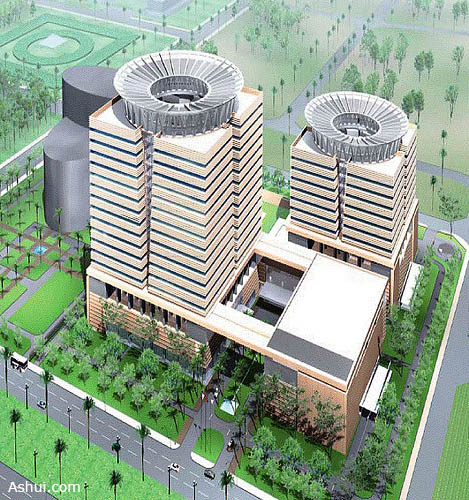 The ‘Lotus Hotel’ project (photo) in Hanoi’s fast-growing western section, capitalized at $500 million, is still listed among the achievements intended to celebrate Hanoi’s 1,000th year. The Riviera Corporation, a Tokyo firm, promised to complete the construction work by the end of 2009.
However, the project is stalled, if not dead. A couple of weeks ago, according to the Hanoi Department of Planning and Investment, it was notified of Riviera’s withdrawal from the project because of the financial problems.
The city is thinking of reassigning the project to Vietnamese investors while awaiting the Prime Minister’s instructions.
Two years ago, the project was the object of fierce competition between Riviera and the much larger South Korean firm, Keangnam. Now it seems the Hanoi authorities are regretting their choice of the Japanese firm.
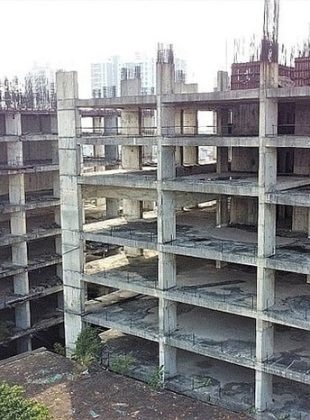
Work has also stopped at the site of another high-profile project, the 65 story ‘Hanoi City Complex,’ finance by Coralis, a Luxembourg-registered real estate developer, on Lieu Nghi Street adjacent to the Daewoo Hotel.
In late 2006, when the $114 million project was licensed, it was advertised as the biggest foreign investment in Hanoi. Coralis committed to expedite the project, to complete it in time for the 1000th anniversary gala. To date, however, only the foundation of the building has been completed. Coralis recently asked for the permission to halt the project because of the lack of capital. Though Vietnamese real estate experts say that the move by the investor signals the ‘bankruptcy’ of the project, it was reported on July 15 that Coralis assets are being acquired by Korea’s Lotte Corporation.
Experts counsel against entertaining illusions
The slow pace of project implementation seems to be the ‘disease’ of many investment projects, and presumably can be blamed in large part on the global recession. The knock-on impacts of the slowed implementation of real estate projects are subtle but costly to the Vietnamese economy, experts say. As long as the tracts sit idle, the large expenses for site clearance are simply monies ‘thrown away.’ And, as the tracts are always located in the most desirable locations, they appropriate the investment opportunities of other investors.
Meanwhile, a leading Vietnamese think tank, the Central Institute of Economic Management (CIEM), has pointed out that the imposing projects are not built just with foreign capital.
According to CIEM, some 70 percent of the capital raised for Vietnamese FDI projects in 2008 was borrowed capital, and included substantial funds raised from Vietnamese domestic sources.
Real estate is the second most attractive sector for foreign investors, and accounted for about 20 percent of all FDI, or more than $34 billion, in July 2009.
A survey of 33 projects apartment and new urban area projects with total investment capital of nearly $10 billion found that the registered stockholder equity was only $2.2 billion only, or just 22 percent of the registered investment capital.
According to CIEM, the survey showed that foreign financial firms are highly leveraged. They only have to put up 20 percent of capital immediately, and then they can mobilize the other 80 percent of capital from ‘domestic’ sources, for example from guests and consumers. This could be understood that the $8 billion come from domestic sources, while it is still recognized as FDI.
The low ratio of chartered capital on the projects’ registered capital shows the low exposure by investors.
The stories about the withdrawal of the investors in the projects show that the success of the projects heavily depends on capital mobilization, not an easy thing in current markets.
A rumour has been spread that the foreign investor of the $1.2 billion building in Hanoi is putting only a few hundred million dollars into the project, while it mobilizes the remaining capital from domestic investors.
Therefore, CIEM expresses concern that that Berjaya Berhad Group (Malaysia) has been assigned to implement four real estate projects at the same time, capitalized at over $5 billion. These include two projects worth $4.5 billion in HCM City, one project in Dong Nai ($750 million) and one in Hanoi ($100 million).
CIEM’s experts have warned that with such a way of capital mobilization, foreign investors will soak up capital which should be flowing to domestic investors and, at the same time, the expected inflows of foreign capital will not be seen.
CIEM is affiliated with Vietnam’s powerful Ministry of Planning and Investment (MPI). However, when queried about economists’ concerns, the head of the Foreign Investment Agency, Phan Huu Thang, told reporters that his agency does not see any big problem in the FDI in the real estate sector.