
Hanoi City is giving positive consideration to implementing a long-term urban development plan it has commissioned from an international consortium. However, the draft plan is drawing fire from Vietnamese experts.
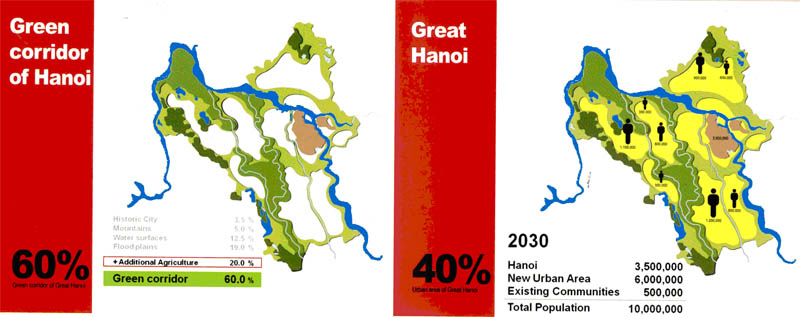
The green belt, which accounts for 60 percent of Hanoi’s area, suggested by PPJ.
Early in July, Hanoi authorities reviewed an ambitious plan for Hanoi’s development to 2030, with a ‘vision’ to 2050. The plan calls for the city’s evolution as ‘the first sustainable capital city.’ It is the work of PPJ, a consortium made up of the US design and architecture firm Perkins Eastman and Posco Engineering &Construction and Jina from South Korea. The Vietnam Institute for Architecture, Urban and Rural Planning (VIAP) also contributed.
The proposal aims at development that embodies four ‘pillars of sustainability’ – economic, environmental, social and cultural, and emphasizes preservation of a ‘green corridor’ in the rich rice growing areas of the former Ha Tay Province. (Ha Tay, to the west of the city center, was annexed to Hanoi a year ago.)
PPJ experts say that the capital city’s plan needs to address many concrete issues, including transport, public spaces, land management, and urban management.
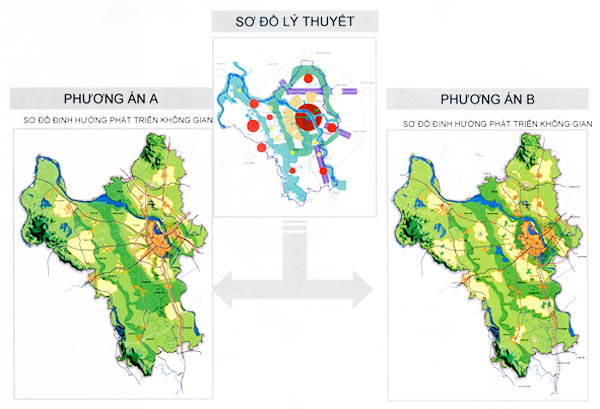
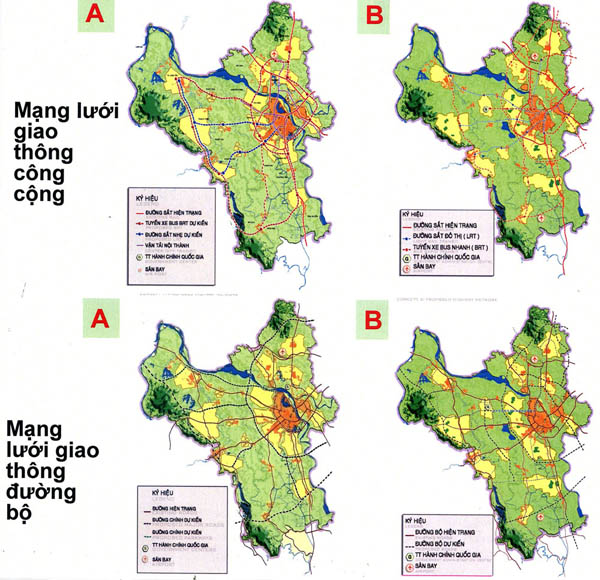
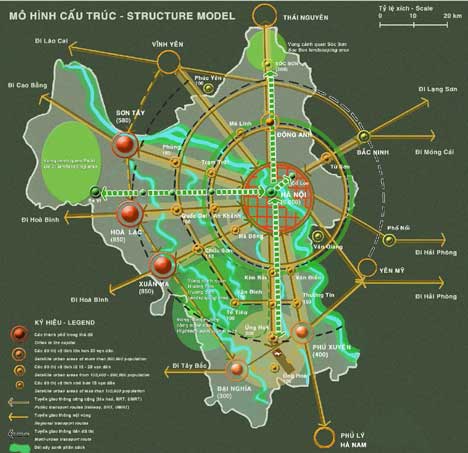 PPJ suggested two options, each with its own strengths and weaknesses. Integral to both is the concept of a ‘green corridor’ that will cover 60 percent of the area of the new capital city, leaving 40 percent for intensive development.
Two-thirds of the green corridor area will be strictly protected against industrial and commercial development, while development in the rest of that area will be consonant with its ‘green’ character. The area for urban development will be shared equally between new towns and existing urbanized areas. This plan is calculated to enable sustainable development of a city with 10 million citizens by 2030.
In option A, two big satellite cities will be developed adjacent to a 10-12 kilometer wide green corridor in the rich agricultural areas near the Day and Tich rivers. A national administrative centre, considerably distant from the current centre in Hanoi’s Ba Dinh and Hoan Kiem districts, will catalyze development along the Red River.
The second option involves less radical departures from current development plans. It centers development on a national administrative centre as the nut, surrounded by satellite cities and residential areas of smaller scale.
Vietnamese experts are quick to comment
The director of the Institute for Construction Planning, La Thi Kim Ngan, considers both options to be infeasible. Ngan said a new national administrative centre located between the Day and Tich rivers is too far from the current one. This area is more suitable for agriculture. Or, if the administrative centre is located to the east of the current city center in Gia Lam district, it can only be accessed from the city’s centre by bridges across the Red River.
Ngan said that the most suitable location for the national administrative centre is the area to the west of West Lake (from the Tay Ho peninsula to Hoai Duc or Tu Liem district).
Hanoi City Chairman Nguyen The Thao said that a national administrative centre that is not closely connected to the current city center will be a ‘dead city,’ so it should be based in the Tay Ho Tay area (west of the West Lake).
Thao asked PPJ to clarify its conception of ‘green corridor’ to avoid eliminating existing villages.
Other experts also said that the ‘green corridor’ idea is interesting but it must be explained clearly.
Dao Ngoc Nghiem, Hanoi’s former chief architect, and Huynh Dang Hi, of the Urban Planning Association both commented that PPJ didn’t discuss population density and population distribution, a necessary foundation for developing infrastructure.
Tran Trong Hanh, a Hanoi People’s Council member and the former rector of the Hanoi Architecture University, said: “I didn’t participate in this project but the consulting unit asked for my opinion. Firstly, I wonder if the period for development of the plan, only about a year, isn’t too short. The scientific foundations for the ideas of PPJ were not proved convincingly”.
Hanh also said that the plan does not differentiate between the urban and general development plans. In addition, economic and social development plans for Hanoi don’t reach to 2050 so this ‘planning vision’ may not match with other plans in the future. As for ‘green areas,’ these have already been foreseen in the 1998 Hanoi development plan and are nothing new.
Hanoi, Hanh said, does not need to use 40 percent of its land for urban development in order to accommodate its projected population. He suggested the rate for urbanization be held to 10-20 percent.
Hanh believes the national administrative centre should be maintained in the current Ba Dinh – Hoan Kiem districts. Other places should be considered as satellites.
In late April, Prime Minister Nguyen Tan Dung and government leaders considered PPJ’s first report, which was less detailed but not much different from the one presented to the Hanoi authorities last week.
While preparing the plan, PPJ held many surveys, seminars and conferences, including international experts, on issues relating to the plan and analysed urban planning experiences from 15 global cities.
According to PPJ, Hanoi has several unique features that need to be addressed. For example, particularly since the annexation of Ha Tay and other adjacent districts last year, Hanoi has a widespread system of villages, including many traditional craft villages that ought to be preserved and developed. Meanwhile, the city’s large agricultural land base is shrinking due to urbanisation, thus agricultural planning needs to be carefully addressed to it continues to thrive in the green corridor, together with infrastructure to add tourism value and serve environmental needs.
PPJ and VIAP have become consultants for the Hanoi Master Construction Plan under contracts worth a combined 6.4 million US dollars. The contracts were signed with the Ministry of Construction in December, 2008.
It is envisioned that the plan will be approved by the Government in time for its promulgation on the occasion of the 1000th Thang Long – Hanoi anniversary (October 10, 2010).
- Photo: HanoiData
[ FORUM ]